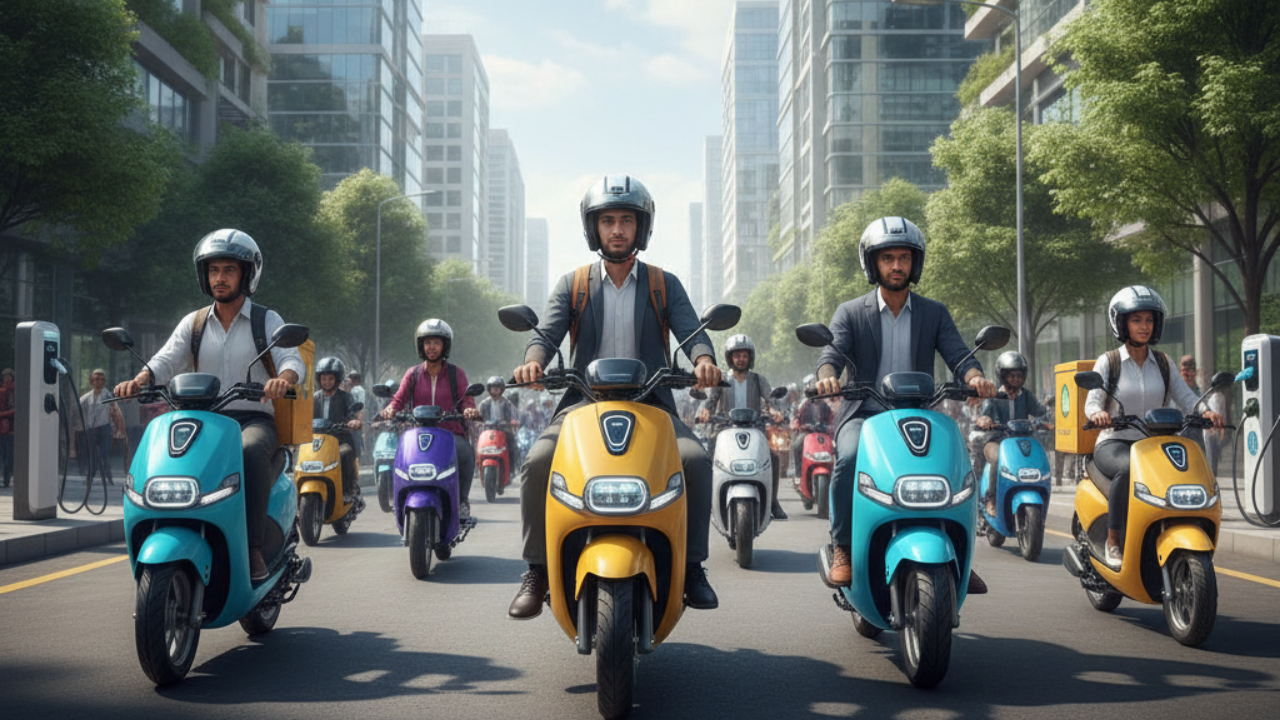

India’s electric vehicle journey is entering a decisive phase. What was once considered a slow-moving and experimental market has now transformed into one of the fastest-growing EV ecosystems globally. According to industry forecasts, the India EV market is projected to reach nearly $17 billion by 2026, growing at a robust CAGR of over 23%. This rapid expansion is being driven primarily by the explosive adoption of electric two-wheelers, strong government policy support, falling battery costs, and rising environmental awareness among consumers.
As fuel prices remain volatile and urban air quality continues to deteriorate, Indian consumers are increasingly viewing electric mobility as both an economical and responsible alternative. The shift is especially visible in cities, where daily commuting patterns perfectly align with EV usage. From delivery riders to office commuters, electric scooters and motorcycles are redefining how India moves. This transformation is not just about vehicles—it represents a structural change in how transportation, energy, and sustainability intersect in the country.
Current Snapshot of India EV Market
While India EV market is still young compared to global leaders like China or the US, recent data indicates exceptional momentum. Sales of electric vehicles have grown exponentially over the past few years, with electric two-wheelers accounting for the majority of volumes. During FY 2022–23, India recorded nearly 2.8 lakh electric two-wheeler sales in just the first half of the fiscal year, marking a growth rate of over 400% compared to the previous year.

Electric passenger vehicles are also gaining traction. Although they form a smaller portion of total EV sales, electric car volumes have seen triple-digit growth year-on-year. Brands like Tata Motors, MG Motor, and Mahindra Electric are steadily expanding their portfolios, making EVs more accessible across price segments. This steady growth highlights a clear shift in consumer confidence, supported by improving charging infrastructure and better product reliability.
Alongside vehicle sales, the battery ecosystem in India is evolving rapidly. Lithium-ion batteries, which account for a significant portion of EV costs, are becoming more affordable due to economies of scale and domestic manufacturing initiatives. Indian companies and startups are increasingly investing in local battery assembly and technology development, reducing dependence on imports and improving long-term cost stability.
Government Policies Driving EV Adoption in India
One of the strongest pillars supporting India’s EV growth is proactive government intervention. Policies like the FAME II (Faster Adoption and Manufacturing of Electric Vehicles) scheme have played a crucial role in making EVs financially viable for consumers and fleet operators. Under this program, subsidies are offered on electric two-wheelers, three-wheelers, passenger cars, and buses, significantly lowering upfront costs.
In parallel, the Production Linked Incentive (PLI) Scheme has been introduced to encourage domestic manufacturing of EV components and advanced battery technologies. This initiative focuses on reducing import dependency while strengthening India’s position as a global EV manufacturing hub. By incentivizing both original equipment manufacturers and component suppliers, the government is creating a self-sustaining EV supply chain.
State-level EV policies further complement national initiatives. Several states have announced incentives such as road tax exemptions, registration fee waivers, and capital subsidies for charging infrastructure. Together, these policies are accelerating adoption while laying the groundwork for long-term industry stability.
The Surge of Electric Two-Wheelers: India EV Market 2026 Growth Engine
The most significant contributor to India EV market growth is undoubtedly the electric two-wheeler segment. Two-wheelers dominate India’s transportation landscape, making up the bulk of personal vehicle ownership. Electrifying this segment delivers immediate benefits in terms of cost savings, emissions reduction, and energy efficiency.
Electric scooters and motorcycles have found widespread acceptance among urban commuters, gig economy workers, and delivery fleets. Brands such as Ola Electric, Ather Energy, and TVS have launched competitive products offering practical range, fast charging, and connected features. Improved performance and lower running costs make electric two-wheelers particularly attractive compared to petrol alternatives.
Industry projections suggest that electric two-wheeler sales could cross two million units annually by 2025, forming over 70% of India’s total EV volume by 2026. This surge is critical not only for market value growth but also for achieving national sustainability targets. Electrifying two-wheelers alone can significantly reduce urban pollution and fuel consumption.
Passenger and Commercial EVs Gain Momentum
Although two-wheelers dominate volumes, passenger and commercial electric vehicles are steadily gaining momentum. Electric cars are becoming more visible on Indian roads, driven by better range, improved charging networks, and rising fuel costs. Tata Motors continues to lead the electric car segment, while new entrants and global brands are preparing aggressive launches over the next few years.
Commercial EVs, particularly electric buses and last-mile delivery vehicles, are emerging as a vital component of India’s electrification strategy. Government-backed electric bus deployments under FAME II are already operational in several cities, improving public transport sustainability. Fleet electrification is also gaining popularity among logistics and e-commerce companies seeking to lower operational costs and meet ESG commitments.
Charging Infrastructure and Battery Manufacturing Expansion
India EV market cannot grow without a reliable charging network, and India is rapidly addressing this challenge. Public charging infrastructure is expanding across metro cities, highways, and commercial hubs. Industry estimates suggest that India could have nearly 50,000 public charging stations by 2026, supported by public-private partnerships and utility-led initiatives.

Battery manufacturing is another key focus area. The PLI scheme for Advanced Chemistry Cell (ACC) batteries aims to establish large-scale domestic battery production. This move is expected to reduce battery costs, improve supply chain resilience, and enable innovation in energy storage technologies. As battery prices decline, EV affordability will improve further, encouraging mass adoption.
Challenges That Could Shape the India EV Market’s Future
Despite impressive progress, India EV market faces several hurdles. High upfront costs, although declining, remain a concern for price-sensitive consumers. Charging infrastructure, while improving, is still unevenly distributed, with rural and semi-urban areas lagging behind.
Battery raw material dependency poses another challenge. India currently relies on imports for critical minerals such as lithium and cobalt, making supply chains vulnerable to global disruptions. Policy execution and coordination across states also require continuous improvement to meet ambitious national targets.
Addressing these challenges will be crucial for sustaining long-term growth and achieving the goal of 30% EV penetration in new vehicle sales by 2030.
Predictions for India EV Market in 2026
By 2026, India’s EV ecosystem is expected to look significantly different from today. Industry forecasts indicate an EV fleet of 7–8 million vehicles, dominated by two-wheelers. Electric vehicles could contribute 10–15% of total new vehicle sales, supported by improving affordability and infrastructure.
The India EV market value is projected to reach approximately $17 billion, encompassing vehicle sales, battery manufacturing, and charging infrastructure investments. Domestic battery production capacity could exceed 20 GWh annually, strengthening India’s position in the global EV supply chain.
Business Opportunities and Investment Potential
India’s EV boom presents massive opportunities for startups, investors, and established players. High-growth areas include EV component manufacturing, charging infrastructure services, fleet electrification, battery recycling, and EV software platforms. Early movers stand to benefit from government incentives and rising demand, while long-term prospects remain strong as India scales its clean mobility ecosystem.
Final Take: India EV Market Is Accelerating Faster Than Ever
India’s journey toward electric mobility is no longer a future vision—it is happening right now. With strong policy backing, rapid two-wheeler electrification, expanding charging infrastructure, and falling battery costs, the India EV market 2026 is set to become one of the most dynamic globally. While challenges remain, the direction is clear and irreversible.
For businesses, investors, and consumers alike, this is the ideal time to engage with India’s EV transformation. The road ahead is electric—and India is charging forward with confidence.
Explore more in-depth India EV market insights, launch updates, and future mobility trends at EV Insights Blogs.
Latest Posts
- Top 5: 150 km Range Electric Scooters in India (2026): No More Range Anxiety!
- Best Electric Vehicles to Buy in India in 2026 (Updated List)
- India EV Market 2026 Could Reach $17 Billion: A Defining Moment for Electric Mobility
- Tata Motors’ ₹18,000 Crore EV Investment Signals a Major Industry Shift
- 10 BIG EV Discounts in December: Up to ₹4 Lakh Off on Affordable Electric Cars


Аплодирую за полезный пост, я сам только что исследовал данный материал!
If you’re looking for options, 188win8 is worth considering. They’ve got a good variety of games and some cool promotions running. Definitely give it a try! 188win8
Downloaded taitranggasv388 app. So much easier than using the browser. Definitely recommend! Check it out: taitranggasv388
I like the helpful information you provide for your articles. I will bookmark your blog and take a look at once more here frequently. I’m slightly certain I’ll learn a lot of new stuff right right here! Good luck for the next!
Looking for a good sg casino online, hope sgcasinoapp.com hits the spot! Let’s see what they have. Get started here: sg casino online
Heard about win2023bet1. Rolling the dice and see if I can strike it rich! Good luck to me or what?! win2023bet1 Let’s get this bread.
B52 Cocktail, always hits the spot! I am looking for a great place that does them right. b52cocktail. Anyone got a favorite bar for these?